
Repair Shop Website Design
People usually search for a garage in an emergency, often from the side of the road with one hand holding their phone. What helps at that moment are only three things: a phone number that can be dialed directly, a location point on the map, and information on whether you are still accepting vehicles today.
What usually holds repair shops back
Your workshop customers are looking when their vehicle is already having problems. The engine dies in the middle of the road, or the car makes a strange noise since morning and they search while standing on the sidewalk with a barely sufficient signal. In that situation, they don't browse catalogs and don't read company profiles. Slow-loading pages are immediately abandoned, and phone numbers placed at the very bottom are never read.
After calling, the next questions are almost always the same: can it be done today or does it need to be overnight, can my matic motorcycle be handled, and if the vehicle can't be driven, can it be picked up. Workshops that have answered these questions on their own page receive calls that directly ask about schedules, because the initial filtering has been completed before the person presses the call button.
There is one concern that is rarely expressed by customers: fear of being cheated. The cost that is only mentioned after the vehicle has been dismantled is a story that almost everyone has their own version of. Workshops that dare to write down routine service rates along with what is included in them eliminate that suspicion before the customer enters the door.
What it can look like for repair shops
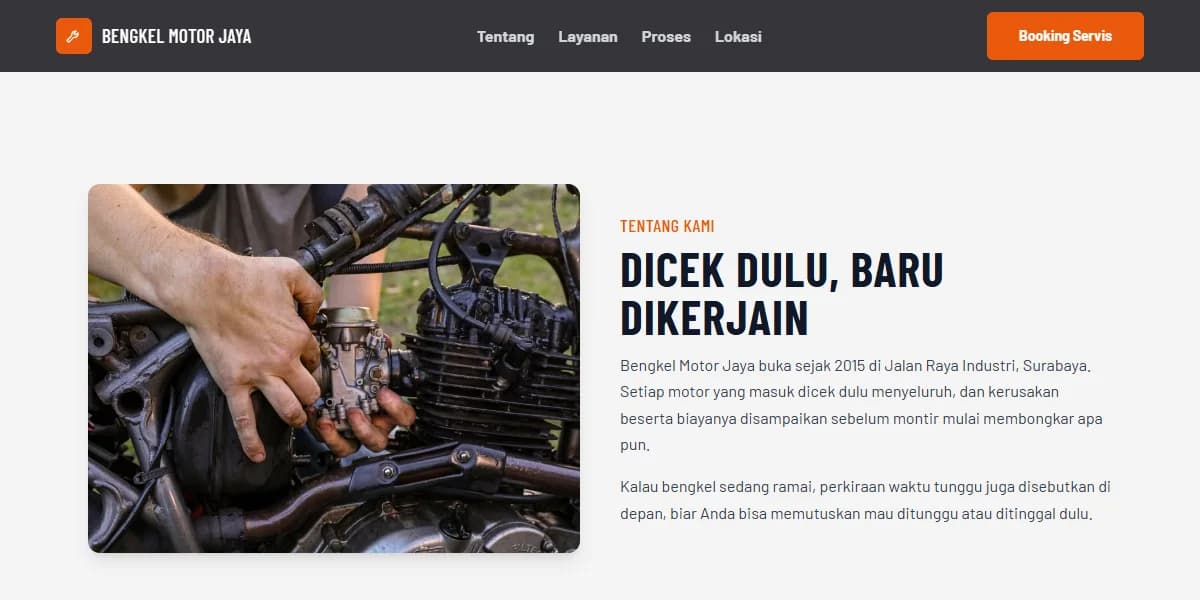
This Bengkel Motor Jaya demo was built by us as an example of the design, not a paid client website. It contains one page: a list of service jobs along with their prices, arranged like a job order sheet commonly used by mechanics, business hours, address, and a WhatsApp button that opens a chat to order a service schedule.
What you get
For a workshop, the most helpful layout for visitors is usually as follows:
- A phone number that can be tapped once, placed at the top and not at the bottom of the page
- Routine service rates such as oil changes, tune-ups, and brake services, complete with what is included in them
- The type of vehicle you handle, so people don't come from far away with a motorcycle that is not your specialty
- Opening hours per day, plus the last hour limit for vehicles to be accepted
- Address with local landmarks, because street names are often not helpful when people are in a panic
- Information on whether you provide call-out or towing services, and up to what radius
What we do not recommend at the beginning: a complete catalog of spare parts with their stock. Workshop stock changes every day, and a page that writes ready for goods that are already out of stock makes people come to be disappointed. A page that is silent about stock is safer than a page that is incorrect, at least until there is someone who is actually in charge of updating it.
Pricing for a repair shop website
A workshop with one location usually requires the Starter package, Rp 1.500.000, which already includes a domain, hosting, and SSL for the first year. The work takes around 3 days since we receive your complete materials, and what is meant by materials here: list of service jobs and their rates, workshop photos, opening hours, and address.
The Business package, Rp 5.000.000 with a work duration of 1 to 2 weeks, is more suitable if you serve both cars and motorcycles at the same time so that the list of rates is long, have more than one branch, or want to write articles on periodic maintenance so that they can be found by people who are looking before their vehicles are damaged. The details are on the package page.
Questions we often get from repair shops
- My service rates depend on the vehicle's condition. Should I write that too?
Write the fixed rates, such as oil changes and minor services, then mention honestly that engine overhauls and part replacements are calculated after inspection. The fixed prices for routine work are enough to make people dare to come, and honest sentences about what cannot be determined are more believable than a page that is completely silent about prices.
- My customers find my garage through Google Maps. What does a website add?
Maps provides location, business hours, and reviews, but that's it. What doesn't fit there is the rate per job, the type of vehicle you handle, and information about call-out services. Your website can also be linked from your Maps profile, so people who have found you on the map have a place to read before calling.
- Can it be displayed whether my garage is currently open or closed?
Daily business hours can be displayed and visitors can immediately see the schedule for that day. What a static page cannot promise is sudden conditions such as a mechanic being sick or the garage being closed due to an event. For things like that, a WhatsApp number that is actually answered is more reliable than any writing on the screen.
- Can you also include a catalog of spare parts along with their stock?
Yes, but that requires a database and an admin panel, so it's a different calculation from a one-page website. Before deciding, think about who will update the stock every day. If the answer is no one, the catalog will be incorrect within two weeks and customers who come based on that page will leave empty-handed.
- How long does it take to complete?
Starter takes around 3 days, Business takes 1 to 2 weeks, counted from when we receive your complete brief and materials, not from when the down payment is made. If the tariff list and workshop photos are not ready, that's usually where the time gets delayed. What needs to be prepared is explained in the article about website construction time.
Next step
Compare what each package includes side by side, or first read what to prepare before you order.
Related pages
Car Showroom Website Design
A car showroom website contains a list of units, mileage, service history, and estimated installments. See the demo, starting from Rp 1.500.000.
Premium Car Showroom Website Design
A premium car showroom website with a curated catalog, complete documents for each unit, and a closed meeting system. See the demo.
Paint Store Website Design
Paint store website with a catalog by surface, a paint quantity calculator, and ordering over WhatsApp. From Rp 1.500.000.
Company Profile Website Design
Company profile website design: services, projects, legal details, and contact information that prospective clients can verify. See the demo, from Rp 1.500.000.