
Paint Store Website Design
People who want to paint their house rarely know how much paint they need. They know their room is approximately three by four meters, and that's it. A page that converts room size into an estimate of the number of cans answers the most frequently asked question in your shop, before the person even types.
What usually holds paint stores back
Paint buyers come with questions that always look alike: how many cans does a wall this size need, is one coat enough or two, and does an old wall that has been painted before need to be stripped first. Answering takes the same small calculation every time, from the wall area minus doors and windows, divided by the coverage per liter written on the product label. You do that sum in your head many times a day, often while serving someone else in front of the shelves.
The second problem has long been a standing complaint in this business: the color on screen is never the same as the real color. Every phone shows color differently, and a color that has dried on a whole room's worth of wall almost always looks darker or paler than the little square on the screen. A page that shows a row of colors without mentioning this is setting up buyers who come back carrying an open can. What you can do is say so plainly, list the color codes, and mention that there is a physical color card in the store.
Third, buyers often come with the wrong choice for the surface. Interior wall paint gets used on an exterior wall exposed to rain, metal paint is bought for wooden window frames, or a gloss finish is chosen for a bedroom with uneven walls so every flaw shows. At the end of that conversation the same question almost always comes up: do you also have a painter. A store that has already answered all of this on its page serves people who arrive with a shopping list.
What it can look like for paint stores
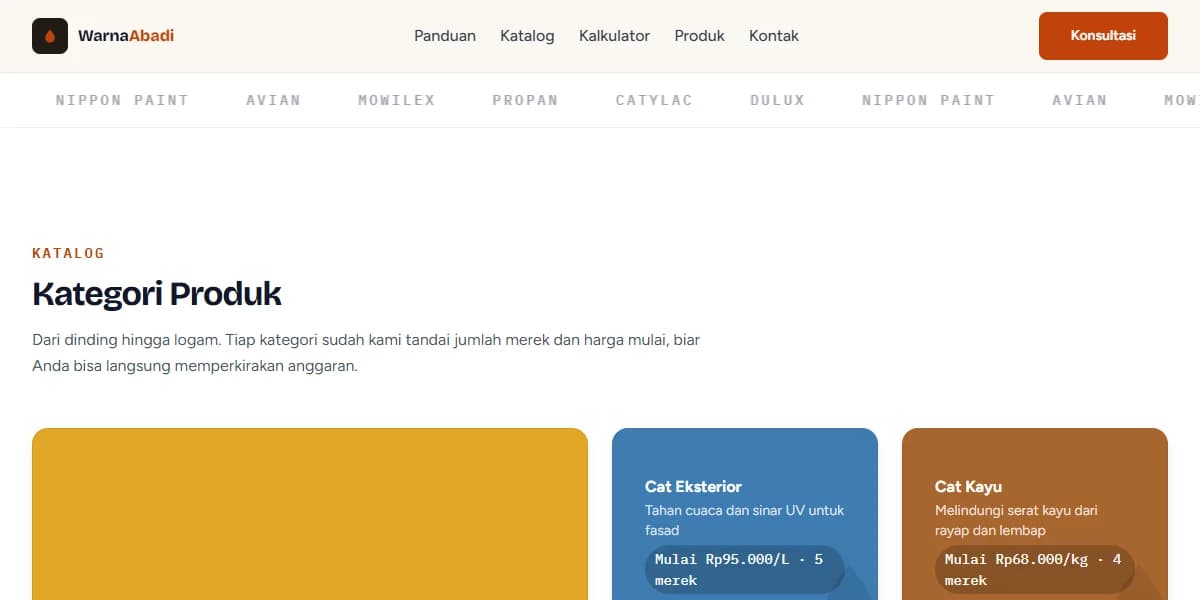
This Warna Abadi demo is built by us as an example of a form, not a paid client website. It contains a catalog grouped by surface type and finish type, a color gallery, a comparison of matte, satin, and gloss results, a paint requirement calculator that asks for the surface area and then outputs an estimated liter amount, and a WhatsApp button for ordering. The calculator runs in the visitor's browser and does not store anything, so the page remains a regular static website.
What you get
For a paint store, the most frequently used content by visitors is usually this:
- Catalogs grouped by surface: interior walls, exterior walls, wood, metal, and roofs, because that's how buyers explain their needs
- Paint requirement calculator that asks for the surface area and provides an estimated liter amount, with the assumptions written openly
- Description of finish types, such as matte, satin, and gloss, along with the rooms they are usually suitable for
- Color codes under each sample, plus a honest statement that screen colors are only estimates
- Packaging sizes that you actually stock, from small cans to pails, along with their prices
- Information on whether you offer on-site color mixing and how long the process takes
- Information on whether you have partner painters and whether their fees are calculated separately from material costs
- WhatsApp button with a ready-to-ship message that already asks for the surface area and type of surface
What we do not recommend at the start: a color preview tool that asks visitors to upload a photo of their wall and then displays the result after it's painted. Besides being expensive to create, the result depends on the lighting when the photo was taken and the screen used to view it, so the tool promises the most in the aspect that is most likely to be inaccurate. A small sample applied to a real wall and viewed in the morning and afternoon answers the same question more convincingly, and that's something you can offer without building anything.
Pricing for a paint store website
A paint shop with one location usually fits with the Starter package, Rp 1.500.000, which already includes a domain, hosting, and SSL for the first year, and is completed around 3 days after we receive your complete materials. The most determining material here is the coverage per liter for each product, which is usually written on the packaging or distributor's brochure.
The Business package, Rp 5.000.000, takes 1 to 2 weeks to complete, and is more suitable if you sell several brands at once and each brand has many types, resulting in a long catalog and large color gallery. In this package, images are stored on Cloudflare CDN, and there is a blog that in this field is usually used to write guides such as how to prepare a damp wall before painting. A comparison of the contents can be found on the package page.
Questions we often get from paint stores
- Does the paint needs calculator require a special system?
No. The calculation runs in the visitor's browser and doesn't store anything, so the page remains static and is still included in the regular package. What you need to prepare is the numbers: the spread rate per liter for each product, and how many coats you recommend for new walls and walls that have been painted before. Write those assumptions near the results so buyers know where the numbers come from.
- The color on the buyer's screen is always different from the actual paint. How safe is it?
Be honest on the product page about the color: the color on the screen is only an estimate and differs on each phone, so the final selection should use a physical color card. Include the official color code under each example so that buyers can mention the code when ordering, because color names are interpreted differently by each person. If you can make a small sample to be applied to the wall, mention that too, because this is what will save you from returns.
- Buyers compare my prices with those on marketplaces. What can I write?
Write things that are not available in the marketplace. Color mixing on site with results that can be seen directly, goods that can be taken on the same day without waiting for a courier, cans that can be checked for seals before being paid for, and people who can be asked when buyers are confused about choosing a finish type. For paint, shipping costs for heavy goods and the risk of dented cans during transport are also valid reasons that you can mention.
- Many people ask about contractors. Should I include that?
Include it as is. If you have a partner contractor, mention how their fees are calculated, whether it's through your store or directly to them, and whether you take responsibility for the work results. If you don't have one, write that you only sell the materials. One sentence can save a lot of conversations that end in disappointment after five minutes.
- My store also sells cement, brushes, and other building supplies. Should I include those too?
Include them, but put them after the paint and make sure they don't take up more space. People type 'paint store in my area', so a page with paint on the front will be found first. Supporting supplies only need a short section mentioning that brushes, rollers, and drop cloths are available, because paint buyers are looking for those too so they don't have to visit two places.
Next step
Compare what each package includes side by side, or first read what to prepare before you order.
Related pages
Property Website Design
Property website with site plan, type and size, KPR scheme, construction progress, and legality. See the demo, starting from Rp 1.500.000.
Repair Shop Website Design
A repair shop website with a one-tap phone number, map, opening hours, and routine service rates. See the demo, from Rp 1.500.000.
Online Store Website Design
Online store website design: a catalog with ordering over WhatsApp, or online checkout and payment. From Rp 5.000.000.
Company Profile Website Design
Company profile website design: services, projects, legal details, and contact information that prospective clients can verify. See the demo, from Rp 1.500.000.