
What Is a Company Profile? Contents, and PDF or Website
10 min readInWebsite
Short answer
A company profile is a document or page that introduces a company to potential clients and partners: what it does, evidence and capacity, legality, and who can be contacted. It can be in PDF format to be attached to proposals, or a website that can be found through Google. The contents of both are the same, so the manuscript only needs to be written once.
The request is usually just one sentence in the chat: "Can you send your company profile first?" The one requesting can be from the procurement department of a potential client or a committee that is collecting a list of vendors. If your company has never had one, two questions immediately follow: what's in it, and is it sent as a PDF or is a website link enough. The arrangement of the content in this article is taken from a demo that we built ourselves, so the business name and numbers that appear in the screenshot are sample entries.
A company profile is an introduction for people who are checking out your company
A company profile, or business profile, is a document that introduces a business to people who are considering working with it. It can be in the form of a PDF file attachment or a website page. CVs and individual businesses that start serving office orders can also be asked to send it, and for them, a few pages are enough.
Its readers are usually checking something. Procurement staff who compile a list of shortlisted suppliers need to know that your company can meet the requirements, and potential clients who hold three quotes want to know who has done similar work before. A useful company profile answers these two things before they need to make a call.
Brochures and proposals have different tasks. Brochures sell one product or promotion and can change every season, while proposals are written for one client and one job, complete with prices. A company profile applies to all readers at once and is only changed when the company itself changes.
A brand profile introduces one brand; a company profile introduces the business entity
A brand profile is the profile of a brand: the story behind the brand, the products sold under its name, the target buyers, and how the brand appears and communicates. The term is not standardized, so the content can vary between companies.
The difference is most evident in companies that have multiple brands. A food manufacturer with three snack brands, for example, only needs one company profile for its business entity, containing its legality, factory, production capacity, and management, while each brand has its own brand profile. Distributors read the former, potential resellers read the latter.
Businesses whose brand name is the same as their company name only need one document for both. If someone asks for a brand profile without explaining its purpose, ask what it will be used for, because the answer determines which parts need to be highlighted.
Brand guidelines are different: rules for using logos, colors, and fonts for designers and printers, so your logo looks the same wherever it is printed.
A company profile's content follows the five questions its readers ask
A company profile contains the company's services or products, proof of work, capacity, legal details, and contacts. The order is easier to put together if each part is paired with the question already in the reader's head:
- What does this company do, and for whom? One opening sentence, then a list of services or products with their scope.
- Have they done something like what I need? A list of projects with their year and location, names of clients who have agreed to be named, and real photos of the work.
- Can they handle a job my size? Capacity, service area, the team's size and skills, and the workflow from order to handover.
- Is this company legitimate? The business entity's name, its Nomor Induk Berusaha (NIB) and any other licenses it actually holds, certifications with their issuing bodies, and the office address.
- If I want to go ahead, who do I talk to? The name and position of the person in charge, a WhatsApp number, the company email, and working hours.
A short history, vision and mission, a message from the leadership, and an organization chart are also common. In our view those parts are rarely looked for at a first introduction, so put them at the back and keep them short. For a company with five employees, one team photo with each person's name and role explains more than an organization chart.
The Kirana Logistics demo puts services and workflow before the company story
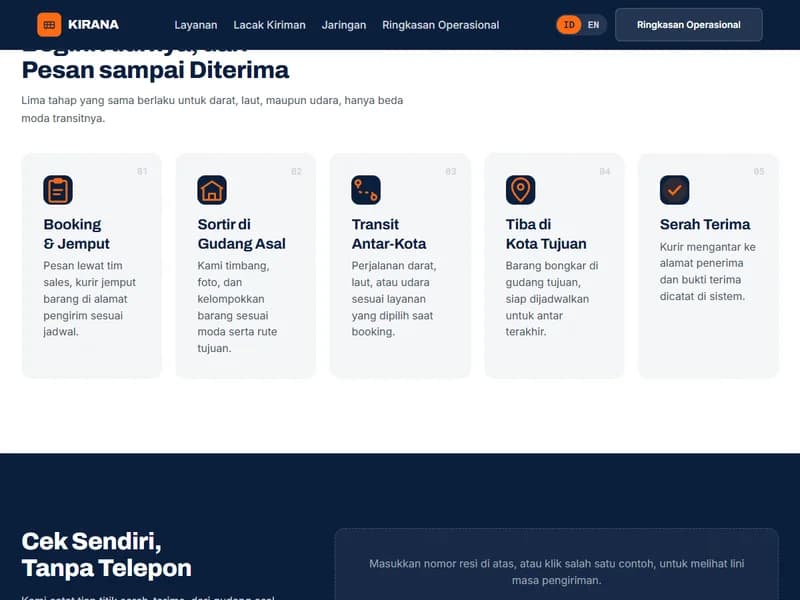
Our Demo Kirana Logistics is arranged as a company profile for a shipping company, with an order that follows the previous questions. The first sentence under the title directly answers the first question: Kirana handles land, sea, and air shipping to all of Indonesia. Right below it, there is a column to check the receipt number for old customers.
The services section breaks down the business into four cards: land, sea, air, and warehouse and fulfillment. Each card contains one specific description, such as FCL and LCL (a full container or shared container) for sea shipping. After that, it follows the five-stage flow from booking to delivery, a list of cities per zone, a tariff calculator, and FAQs about damaged goods claims and insurance, then a WhatsApp button for shipping consultation. We did not include vision, mission, history, and director's greeting, because the procurement staff who are looking for an expedition first need to know what kind of shipping can be handled and what happens if the goods are damaged.
The list of customer company names and testimonials in the demo are fillers to show their location. In a real company profile, both can only contain clients who have agreed to have their names used. The receipt tracking and tariff calculator are also sample displays; to display real shipping data, the website must be connected to the company's operational system, and that connection is calculated separately by us.
Other examples by business type, from housing developers to branch clinics, we collect in the article company profile website examples.
Three promises clients can hold you to explain a company faster than a vision and mission
Vision and mission are generally written as a direction for the management and employees themselves. For potential clients, phrases like "prioritizing customer satisfaction" do not answer what will happen if their message has problems.
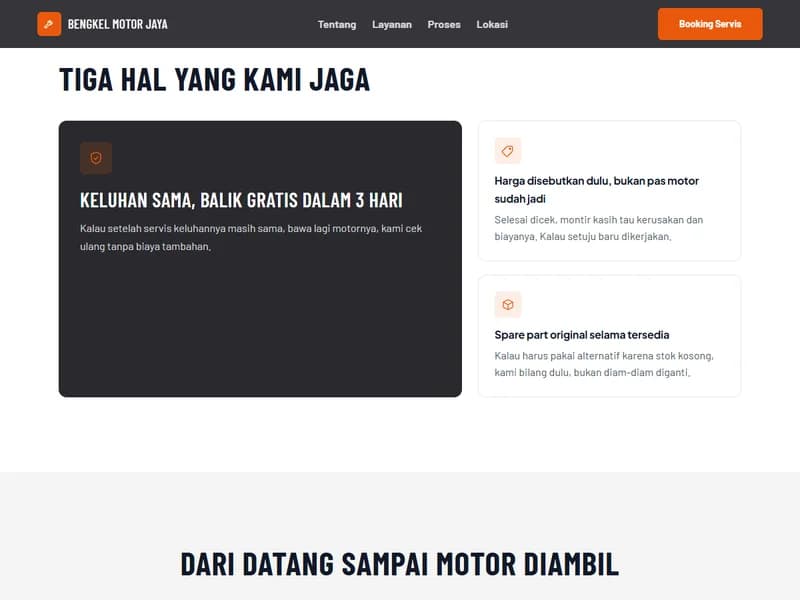
In the position that is often filled with vision and mission, right after the about section, the demo of Bengkel Motor Jaya installs Three Things We Maintain. The same complaint after service is checked again for free within 3 days. The price is stated before the motor is worked on. Original spare parts are used as long as stock is available, and if a replacement must be used, the customer is informed first. All three can be claimed: if the workshop violates one of them, the customer knows exactly what was violated.
Larger companies can use the same pattern, for example by writing the warranty period for the work or the deadline for you to send a quote after being requested. If the official vision and mission must still be included, either because they have been determined by the management or requested by the parent company, one sentence for each is enough.
Making a company profile starts with material that can be verified; the design comes later
Choosing a design template first forces the content to fit into boxes made for other companies. A faster way to finish is like this:
- Determine one main reader and the decision they are currently making. The procurement section of a factory that chooses a supplier looks for capacity and legality, while a couple choosing a wedding caterer looks for food photos and prices per serving.
- Gather materials for the five questions above before writing anything. Lists of projects and their photos are usually the longest to collect, so start from there, and ask for written permission before mentioning a client's name or posting their logo.
- Write the opening sentence: the company name, what it does, for whom, and in which area. If this sentence cannot be written yet, other parts will be unclear too.
- Arrange the parts in the order of the questions above.
- Choose the format: PDF, website, or both. The considerations are in the following section.
Before sending it to anyone, test it with one person who does not know your company. Give them one minute, then ask them to answer three things: what this company does, who it has worked for, and who to contact. The parts they cannot answer are the parts that need to be rewritten.
PDF or website depends on how the company profile reaches its readers
A PDF is suitable if your company profile is mainly sent as an attachment: tender documents, vendor registration, proposals, or introductory emails. The layout remains the same on any computer and can be printed as is.
Its weakness appears after the file is sent. The copy in someone else's folder does not update when you update the original file. Files filled with project photos quickly become large, while personal Gmail accounts limit attachments to 25 MB and replace larger files with Google Drive links. On a mobile phone screen, A4-sized pages also need to be enlarged and scrolled to be read.
A website is suitable if readers come from other directions: typing your company name in Google, or receiving a link via WhatsApp and opening it on their mobile phone. Google can indeed index PDF files that are uploaded to a web address, but PDFs that only circulate via chat and email do not have such an address.
If you experience both situations, create both from one manuscript. The website holds the latest version and the PDF becomes a copy for attachment. Write the version date and website address on the PDF cover, so that people holding older copies know where to check.
The website is also always up-to-date only if someone updates it. Before choosing, decide who will add new projects to it and how often.
A company profile website with us starts from Rp 1.500.000
What we do is the website version. The Starter package, Rp 1.500.000, is sufficient for small companies with several services: one page that contains all company information in one flow, with a WhatsApp button and a contact form that goes to your email. Basic SEO makes the page ready to be indexed by Google. The .com domain, hosting, and SSL for the first year are already included, and the work takes around 3 days since we receive the brief and complete materials. We built the Kirana Logistics demo itself within the limits of this package: one page, without a database.
The Business package, Rp 5.000.000, with a completion time of 1 to 2 weeks, is suitable for companies that need several pages and a blog, with a project gallery whose photos are stored in Cloudflare Storage and CDN. Neither of these two packages has a panel to change the content yourself. In the Business package, you can ask us to add or replace images during the one-month support period. A company profile that requires employee login or an admin panel to change the content yourself falls under the Enterprise package, starting at Rp 15.000.000.
The contents of the three packages are listed together on the pricing page, and considerations by company size are on the company profile website design page. If you already have a company profile PDF, send the file during the free consultation, which takes about 30 minutes before the proposal. The content can be used as initial material for the website version, and we will help prepare any missing text from the start.
Next step
Compare what each package includes side by side, or see finished work closest to your kind of business.
More articles
Company Profile Website Examples by Business Type (Try Them)
Examples of company profile websites by business type, from housing developers to contractors and clinics, with worthy sections to imitate and packages.
Landing Page Examples and How They Differ from a Regular Website
Landing page examples from our demos, broken down by section: layouts for services, hijab, herbal, and tourism, how to build one, and free options with their limits.