
Wedding Planner Website Design
Prospective clients find you six to twelve months before the wedding day, then save your link and open it again weeks later with their partner and parents. What they need from your page is material for comparison that they're compiling: package details, portfolio per event, and initial numbers that can be entered into their budget.
What usually holds wedding planners back
A wedding is ordered once in a lifetime, and the decision-making process is long. Prospective clients start looking far before the date is set, saving a few names, and then comparing them over weeks while taking care of other things. The link they save must remain accessible and still contain the same information when they return. Social media uploads that have been shifted by dozens of new uploads do not do that, and chats containing package details will sink among conversations with other vendors.
The comparison itself is usually done thoroughly, often in one table containing five to ten names. What is included in each package, how many people will attend on the day, whether decorations and catering are included or separate vendors, how far the assistance before the event goes, and the starting price are included in the table. Vendors whose pages only write package names without details do not have entries for those columns, and those with empty columns are usually crossed out first.
Thirdly, the decision rarely stops at the couple. Parents from both sides also weigh in, often with questions that have never been directly asked to you. A page that can be sent to the family group and read completely without you having to explain again helps prospective clients convince parties who have never attended meetings.
What it can look like for wedding planners
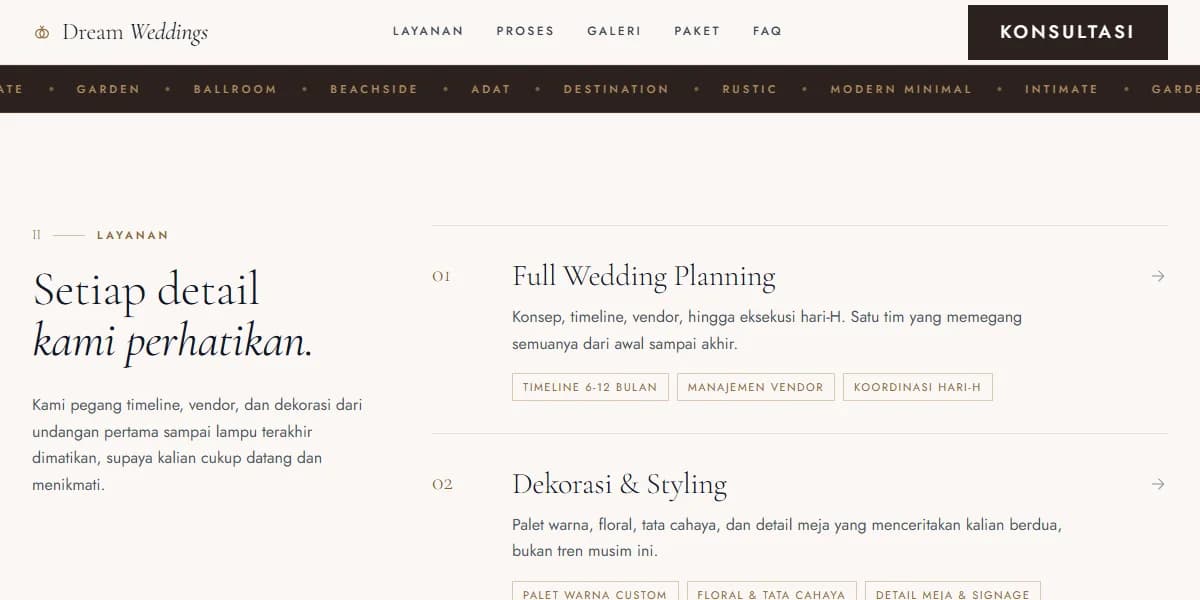
This demo was built by us as an example of the format, not a paid client's website. It contains tiered packages with details of each, a portfolio gallery of weddings, a sample testimonial section, and a consultation button that opens WhatsApp. The arrangement is deliberately giving the most space to the portfolio and package details, because those are the two things that prospective clients read the longest.
What you get
For wedding planners, the content that potential clients actually use when comparing usually includes:
- Portfolio organized per event, not a collection of loose photos: one event per set of photos with a description of the concept, location, and estimated number of guests
- Details of each package, written as a list that can be copied into a comparison table by potential clients
- The number of people from your team who will be working on the event day, and who will be the person in charge on site
- Clear work boundaries: which vendors you coordinate and which ones the client needs to find themselves
- Workflow from the first meeting to the event day, including when you usually start getting involved
- Starting price per package, so potential clients know their budget before contacting you
- Question form that already asks for the event date, location, and estimated number of guests, so your first response can be more detailed
What we do not recommend at the beginning: a public calendar of available dates. Dates that appear to be available but are actually already booked by other clients can disappoint people at the exact point when they have already imagined their event with you. On the other hand, dates that appear to be fully booked may still be available for discussion, because sometimes you can still take on two events on the same date, one in the morning and one in the evening. As long as no one updates the calendar every time a down payment is made, a single sentence asking potential clients to inquire about dates via WhatsApp is much safer.
Event organizers for events other than weddings can use a similar pattern: portfolio per event, package details, and a form that asks for the date and number of guests. The difference lies in the grouping. If you handle corporate events, birthdays, and exhibitions all at once, separate your portfolio by event type, because corporate and individual clients check for different things.
Pricing for a wedding planner website
A wedding planner who works alone or with a small team usually needs the Starter package, Rp 1.500.000, which already includes a domain, hosting, and SSL for the first year, and is completed around 3 days after we receive your complete materials.
In this field, the Business package, Rp 5.000.000 with a processing time of 1 to 2 weeks, is more reasonable than in other industries, because your portfolio contains all photos and there are many of them. In this package, images are stored in Cloudflare CDN so that a large gallery does not slow down the page, there is space for separate pages per event, and there is a blog for writing about wedding preparations that prospective brides and grooms search for long before they look for vendor names. The comparison of the contents is available on the package page, and regarding why large photos can slow down the page, we explain it in the article about CDN.
Questions we often get from wedding planners
- My prices are always adjusted per event. Does it need to be written on the website?
Write the starting price per package, even if the final amount will be different. Prospective brides and grooms prepare their total budget first, divide it among decorations, catering, attire, and documentation, and then look for vendors that fit each category. Vendors that do not provide any numbers are difficult to include in that division, and are often crossed out early on because potential clients are afraid of liking something that is beyond their reach.
- Can I post photos of previous client events in my portfolio?
Ask your partner's permission first, it's best to be in writing, because wedding photos are a personal matter of their family. One thing that is often overlooked: also check the contract with the photographer. In many agreements, the rights to the photos belong to the photographer and you are only given permission to use them for certain purposes. Mentioning the photographer's name under each set of photos solves most of these problems and makes your partner happy.
- I work alone, not in a big team. Will the website make me look bigger than I actually am?
If you write it as it is, no. Just mention honestly how many people will be involved on the day of the event and who will be in charge on the field, because this is a technical question that will definitely arise before signing. A planner who writes about their small team from the start also filters clients by themselves: those who contact you already know what kind of assistance they will get.
- Most of my clients come from referrals. What's the point of having a website?
The person who is referred almost always searches for your name before contacting you, especially for expenses like this. What they find at that moment determines whether they will send a message. A page containing a portfolio and package details completes that check, and also gives the person who refers you an easy link to send.
- I have hundreds of photos from dozens of events. Should all of them be displayed?
Don't. Choose five to eight events that best represent the type of work you want to accept again, then take six to ten photos from each event. A gallery filled with everything makes the page slow and makes potential clients scroll long without reaching a decision. A tightly curated portfolio also does one other thing: the events you display determine the type of events that people will offer you next.
Next step
Compare what each package includes side by side, or first read what to prepare before you order.
Related pages
Florist Website Design
Florist website with a catalog per moment, delivery time limits, and ordering via WhatsApp. See the demo, prices start from Rp 1.500.000.
Hotel Website Design
Hotel website with room photos as they are, facilities, stay policies, and reasons to book directly. See the demo, starting from Rp 1.500.000.
Café and Coffee Shop Website Design
Café and coffee shop website with your menu, photos of the space, last order time, power outlets and wifi, plus reservations for restaurants. See the demo, from Rp 1.500.000.
Company Profile Website Design
Company profile website design: services, projects, legal details, and contact information that prospective clients can verify. See the demo, from Rp 1.500.000.