
Tourist Attraction Website Design
A tourist attraction's page is almost always opened on a phone by someone planning their day, sometimes already on the road. Everything they look for is practical: how much is a ticket today, how late are you open, what's inside, and is there enough time if they only arrive at two in the afternoon.
What usually holds tourist attractions back
What is most often sought after is the ticket price, and in one tourist spot, a single figure is rarely enough. The rate for regular days is different from weekends and national holidays, children under a certain height are often free, groups have their own price, and some rides are paid separately inside. A family of five is calculating the total before departing, so a page that only displays a single figure prepares for an unpleasant conversation at the ticket counter, precisely when the children are already impatient.
The next question is rarely written by anyone: how long does it take to be inside. People plan a day that includes several places, so they need to know how large the area is, whether the route is circular or back and forth, and whether two hours are enough or not enough. Without that estimate, your place is difficult to include in their plan and often loses to other places with a clearer description, even if the content is not necessarily better.
The third is the thing that determines whether the family will leave or cancel. How many cars can the parking lot accommodate and can it be entered by bus or not, is there a place to eat inside or are visitors allowed to bring their own food, are there decent mosques and toilets, can the route be passed by wheelchairs and baby strollers, and how shady is it if you come in the afternoon. Groups that bring toddlers or elderly people make decisions based on these answers, and if the answers are not found anywhere, they choose a place that has already answered them.
What it can look like for tourist attractions
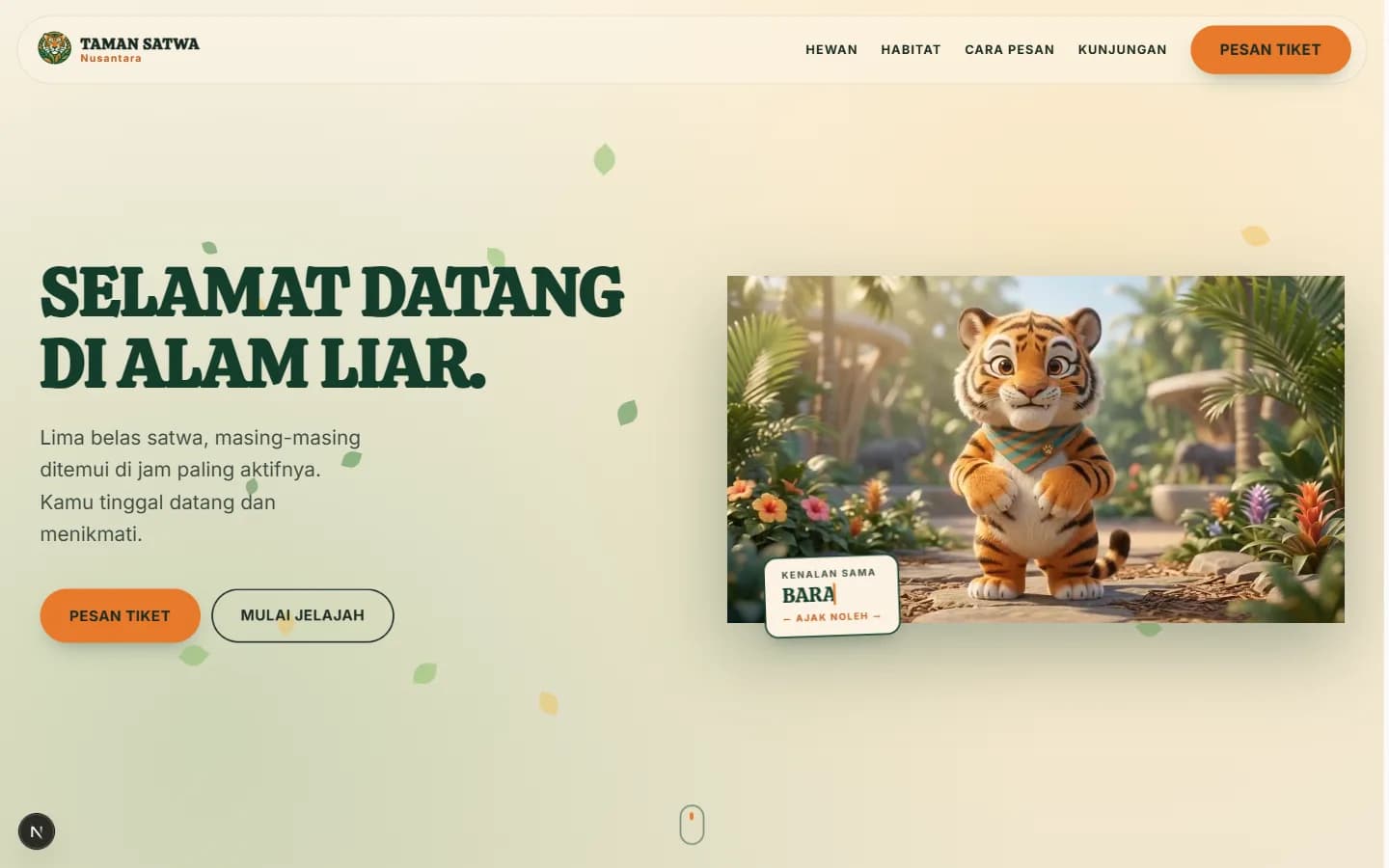
This Nusantara Wildlife Park demo was built by us as an example of the form, not a real operating park website. It contains a scrolling journey that moves one by one through five habitats, from savannas, forests, swamps, night gardens, to family gardens, with a four-panel curtain that closes between transitions, left and right arrows to switch animals in the active habitat, and a tiger mascot whose gaze follows the cursor. This type of form is included in the Business package and requires photos and videos that you already have, so if the park's material is not yet complete, we usually suggest starting with an information page first.
What you get
For tourist attractions, the information that is really useful for visitors before they depart usually includes:
- A complete list of tickets: weekdays, weekends, national holidays, children, groups, and separate paid attractions inside
- Opening hours per day along with the last ticket counter hour, as they often differ by one hour
- What is available inside, with an estimated time to enjoy everything and for a short visit
- A map of the area in one image that can be saved to a mobile phone gallery, so it remains accessible when the signal inside is lost
- Parking information: car and motorcycle capacity, whether buses can enter, the tariff, and the location of the entrance
- Dining places inside, their opening hours, and rules for bringing outside food
- Mosque, toilet, nursing room, and shelter locations, written along with their location in the area
- Honest information about wheelchair and stroller access, including parts that are actually stairs or rocky roads
- How to get there from the most common direction, with a link that directly opens a navigation application
- A link to a ticket selling partner if you have already collaborated with one
What we do not recommend at the beginning: an interactive area map where each attraction can be clicked to display information. It is expensive, takes a long time to make, and the result is most needed when visitors are already inside the area, where mobile signals are often weak in many tourist locations. One map image that can be saved to a gallery does the job without any signal at all, can be zoomed in with two fingers, and you can also print it to post at the gate.
Pricing for a tourist attraction website
A tourist destination typically contains a lot of content, mostly in the form of images, so the Business package, priced at Rp 5.000.000 with a completion time of 1 to 2 weeks, is usually the most reasonable choice. This package includes storing photos in Cloudflare's CDN, which keeps the gallery area loading quickly on mobile networks, provides space for separate pages per attraction or per zone, and includes a blog that is often used to write visit guides and route recommendations in the area.
The Starter package, priced at Rp 1.500.000 with a completion time of around 3 days, is sufficient for small-scale tourist destinations where all the information can fit on one page, such as a village-managed waterfall or a single pick-and-pay garden. A comparison of the contents can be found on the package page, and we explain why large photos can slow down pages in our article about CDN.
For tourist villages managed by pokdarwis or BUMDes, we compare the choice of the .desa.id domain and the free village information system in our article on the cost of making a village website.
Questions we often get from tourist attractions
- Our ticket prices go up during long holidays. How do we write that?
Write its structure: weekdays, weekends, and national holidays each separately, then list the effective dates below the table. For long holidays whose tariffs are determined closer to the date, mention outright that the prices will be announced approaching the date. Visitors who know there are special tariffs will not feel cheated at the counter, and that's what determines whether they return next year.
- Our tickets are already sold through a travel app. Is a website still needed?
The travel app sells the tickets and stops there. What's not available there are practical answers that actually determine the trip: whether the bus parking is available or not, whether outside food is allowed or not, how many hours are needed inside, and whether the route is stroller-friendly or not. Your own page can also link to that app, so visitors who are used to ordering there are still served.
- Visits are very dependent on the weather. Can a website help?
Yes, with one short section about rain. Write which rides remain operational during rain, which ones are closed for safety, where visitors can take shelter, and what the ticket policy is if it rains before or after entry. This is the most frequently asked question throughout the rainy season, and answering it on the page keeps people from cancelling their trip because they already know what to expect if the weather changes.
- The signal in our area is bad. What needs to be considered?
Prepare things that visitors can save before entering: an area map as a single image, a schedule of shows or animal feedings as short text that's easy to take a photo of, and the contact number of the officer who can be contacted. The information page itself we make lightweight so it can still be opened with a single bar signal at the gate, and that's actually how a static website has worked from the start.
- Many people ask if our place is child-friendly and wheelchair-accessible.
Answer with verifiable details, including parts that cannot be skipped. Mention how long the main route is, whether the surface is paved or earth, where there are stairs, whether there are ramps, and at which point strollers need to be left behind. Families with toddlers or family members in wheelchairs appreciate straightforward information much more than pages that claim to be suitable for all ages without details, because they have been misled by such phrases before.
Next step
Compare what each package includes side by side, or first read what to prepare before you order.
Related pages
Hotel Website Design
Hotel website with room photos as they are, facilities, stay policies, and reasons to book directly. See the demo, starting from Rp 1.500.000.
Café and Coffee Shop Website Design
Café and coffee shop website with your menu, photos of the space, last order time, power outlets and wifi, plus reservations for restaurants. See the demo, from Rp 1.500.000.
Wedding Planner Website Design
Wedding planner website with portfolio per event, package details, and inquiry form. See the demo, prices start from Rp 1.500.000.
Company Profile Website Design
Company profile website design: services, projects, legal details, and contact information that prospective clients can verify. See the demo, from Rp 1.500.000.