
Tutoring Center Website Design
At a tutoring center, the person who pays and the person who learns are two different people, and they open the same page with different questions. Parents look for who the teachers are, when the schedules are, and how much the fees are. The children want to know what the classes are like and how many people are in them.
What usually holds tutoring centers back
The decision to sign up for a tutoring center is almost never made by one person. A high school student finds you first through search, reads the page on their own, then shows it to their parents if it makes sense to them. At home, the parents read different parts: the fees, the schedule, and who will be teaching their child. A page that speaks to only one of them stalls halfway, because one has nothing to convince the other with.
Parents' own questions almost always repeat, and the answers don't change. Who are the tutors and what is their educational background, what time are the classes and do they clash with school, are fees charged per month or per session, how many students are in a class, and if the child can't attend, is the session lost. All of it gets asked in long chats, often at nine at night after the kids are asleep, and you type the same answers yet again.
The third obstacle is proof. A tutoring center is hard to judge before trying it, and parents have been offered success rates they can't verify too many times. What actually builds trust are small things they can check for themselves: tutors' names along with their university and subject, the number of students per class, the materials used, and a trial class they can join before paying in full.
What it can look like for tutoring centers
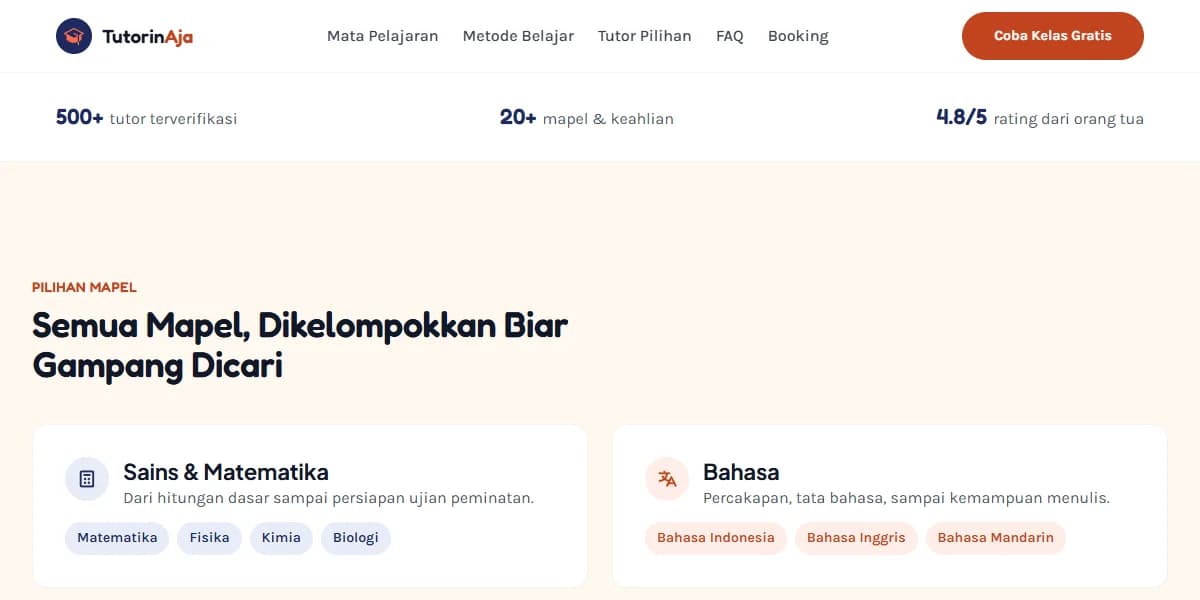
This TutorinAja demo was built by us as an example of the form, not a real operating tutoring center website. It contains a composition by level from kindergarten to university, division by subject, preparation routes for exams such as OSN and UTBK, teacher profiles along with the subjects they handle, as well as choices of online and face-to-face classes. The scheduling form in the demo is just a display form. Scheduling that actually stores data requires a database and someone to check it every day, so the calculation is different and we always discuss it separately before you decide.
What you get
For a tutoring center, the content that two readers usually look for at the same time includes:
- Teacher profile: name, subject taught, and educational background, because this is the first question parents ask
- Levels and subjects you offer, including exam preparation paths if available
- Class schedules per day, with notes on which ones start after school hours and which ones are on weekends
- Fees, written as is per month or per meeting, along with what's included like modules and tryouts
- Number of students per class, plus notes on private classes if you provide them
- Terms if a student is absent: forfeited, replaced, or moved to another class
- Address and notes on face-to-face or online classes, complete with the applications used
- WhatsApp registration number with an initial message that already mentions the level and subject
What we don't recommend at the start: displaying success numbers like the percentage of students who pass PTN, and posting photos of students along with their school names. Success numbers require records that you can show when parents ask about them, and once one number is questionable, the entire page is doubted. Student photos are different: most of them are minors, so permission must come from parents and should be written. Class atmosphere photos taken from behind while working on the same task without risk are fine.
Pricing for a tutoring center website
A tutoring center with one location is sufficient with the Starter package, Rp 1.500.000, which already includes a domain, hosting, and SSL for the first year, and will be completed around 3 days after we receive your complete materials. The materials in question are: list of teachers and their subjects, class schedules, and fee lists.
The Business package, Rp 5.000.000, takes 1 to 2 weeks to complete, and is more suitable if you have many teachers who need their own profile pages, or if you want to write about exam discussions and materials on a blog. In the tutoring center field, writings like that are one of the most natural ways to be found, because students look for exam discussions much more often than they look for the name of a tutoring center. The contents of each package can be compared on the package page.
Questions we often get from tutoring centers
- Can you write down what percentage of our students pass the PTN?
You can, if you really have the records, and write down the numbers complete with context: what year, out of how many students who took part, and through what pathway. If those records don't exist, don't estimate. Parents who are comparing several tutoring centers will ask for the details when they meet, and numbers that you can't break down at that point will harm more than help.
- We have many photos of students while they're studying. Can they be posted?
Ask for written permission from the parents first, because most of your students are minors and verbal permission from the child is not enough. If getting that permission is troublesome, take photos of the room from behind so faces are not visible, or photos of the tables, blackboards, and modules used. What parents really want to see is the state of the room.
- Who reads this page, parents or their children?
Both, and that can be arranged through the order of the content. The top part is for parents: teachers, schedules, fees, and the number of students per class. After that, the part that explains how the classes run, the materials used, and the form of exercise questions, which is more read by the students. One thing that's often overlooked: provide a link that's easy to resend, because your child will send it to the family group.
- Our class schedules change every semester. Is it troublesome to update them?
Schedule changes are included in small tasks that we can help with. Another method that's often used: write down the schedule pattern only, for example, IPA SMA classes run on Tuesdays and Thursdays in the afternoon, then ask prospective students to confirm the exact time via WhatsApp when registering. Patterns like that remain correct even if the time shifts by half an hour in the next semester.
- Our tutoring center is new and doesn't have alumni yet. What should the page be filled with?
Fill it with things that can be checked now: the background of the teachers, the subjects opened, the number of students per class, the materials and books used, as well as trial classes if you offer them. A new tutoring center that openly says it's just starting and offers a trial meeting is usually more attractive to parents than one that claims to have been around for a long time but doesn't mention the names of its teachers.
Next step
Compare what each package includes side by side, or first read what to prepare before you order.
Related pages
School Website Design
A school website contains profiles, SPMB/PPDB info, fees, teachers, activities, and contacts sought by prospective parents. Prices start from Rp 1.500.000.
Clinic Website Design
A clinic website contains doctor practice schedules, service lists, branch information, and registration via WhatsApp. Prices start from Rp 1.500.000.
Creative Agency Website Design
A creative agency website contains case studies along with their processes, team profiles, and how to start a collaboration. See the demo, starting from Rp 1.500.000.
Company Profile Website Design
Company profile website design: services, projects, legal details, and contact information that prospective clients can verify. See the demo, from Rp 1.500.000.