
Property Website Design
Buying a house is the biggest and longest decision your visitors will make. The link they save today will be opened again weeks later, on a different screen, with their partner and often with their parents. Your page must continue to answer with the same thing every time it's opened.
What usually holds property businesses back
The first thing that home buyers consider is the location, and this assessment is far more detailed than what is usually written in advertisements. They want to know the exact point on the map, the width of the entrance road and whether it can be passed by two cars or not, how far it is to their child's school, to the market, to the nearest hospital, and whether the area is prone to flooding. Phrases like 'strategic location' and 'ten minutes to the toll gate' without a specific map point actually raise suspicions, because they know that the ten minutes are measured at what time, which is very determining.
After location, the contents are compared. Site plans are needed so that they know which plot faces which direction and which one is adjacent to the main road, house types with land and building sizes along with their floor plans, and then payment schemes starting from cash, installment, to mortgage with which banks you are working with. If the building has not been built yet, one more thing is added to the list: how far the progress is now, proven by dated photos.
The third thing is rarely spoken but always on the buyer's mind, which is the fear of being deceived. Stories of stalled projects after the down payment has been made have been circulating too often, so potential buyers check things that they can verify themselves: what is the status of the land, has the master certificate been split or not, has the permit been issued or is it still being processed, and which legal entity is selling. We do not write profit projections or promises of price increases on the property page, and if you have materials that have been approved by the developer's legal department, we use those materials.
What it can look like for property businesses
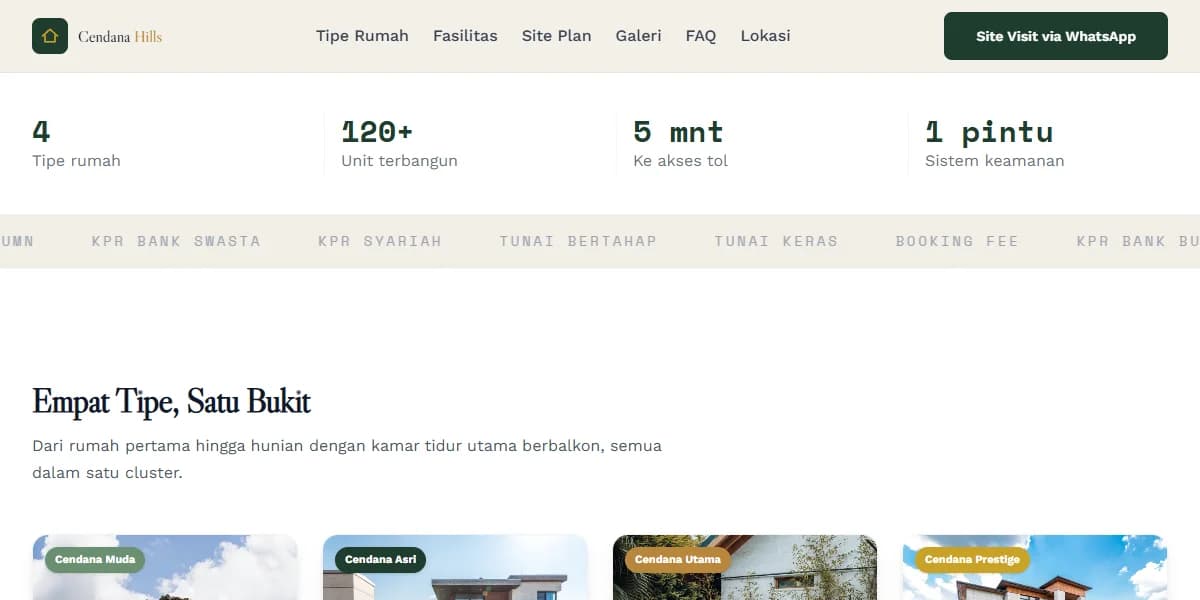
This Cendana Hills demo was built by us as an example of the format, not a real operational developer website. It contains cards with house types, including land area, building area, and prices, a site plan showing the availability of each unit, a list of partner banks for KPR, a four-step purchase process from survey to key handover, and scheduling of visits via WhatsApp. One note that we always convey before imitating it: the unit status on the site plan is only useful if someone marks it as sold on the same day the down payment is made.
What you get
For property, the content that usually determines whether potential buyers proceed or stop is this:
- The actual location point on the map that can be opened in a navigation application, not just an image of a map that marks the area
- The distance to daily facilities, complete with the names of schools, markets, and hospitals
- Site plan with plot numbers, facing directions, and road widths in front of each block
- House type with land area, building area, number of rooms, and floor plans that can be enlarged
- Building specifications as they are, from foundations, roof frames, to ceramic and sanitary brands used
- Complete payment scheme: cash, installment with the number of terms, and mortgage with a list of partner banks
- Progress photos of construction with the date of capture, if the unit is not yet complete
- Legal status as it is, including those still in process, along with the name of the seller's legal entity
- How to schedule a visit to the location, because the decision is almost never made before the person stands on the plot
What we do not recommend at the beginning: installing profit projections such as estimated annual price increases or rental yield estimates. Figures like that are promises of something you do not control, and buyers keep them. Two years later, when the market price turns out to be moving slower, the same page is used to demand from you, and property buyers have the time and reason to pursue it further. Comparable data that can be traced, such as transaction prices in the same area in recent years, does the job of convincing without becoming a promise.
Pricing for a property website
In the property sector, the Business package at Rp 5.000.000 with a completion time of 1 to 2 weeks is often the most honest answer. A single housing project already contains several types of houses with their respective floor plans, site plans, location galleries, progress photos that increase every month, and a legality section. In this package, images are stored on Cloudflare's CDN, so floor plans and progress photos do not make the page heavy on mobile networks, and there is a blog to write about things that people are actually looking for before they search for the name of the housing, such as mortgage application requirements.
The Starter package, at Rp 1.500.000 with a completion time of around 3 days, is still suitable for individual agents or small projects with one or two types. A comparison of the contents can be found on the package page.
Questions we often get from property businesses
- Our unit prices increase with each sales term. Should they still be written on the website?
Write the starting price per type, and then mention the effective date next to the number. Home buyers plan their budget and calculate their loan eligibility before contacting anyone, so a page without numbers at all will be skipped. Prices with dates also protect you when the prices go up, because buyers see for themselves that what they're reading is the price for a specific date.
- Our land certificate has not been split. How do we write the legality?
Write the actual condition: what is the current status of the land, what stage is the certificate division at, and an estimate of when it will be completed if you have a schedule. Do not write about ownership certificates per unit before the certificates are actually issued. Serious buyers will check with a notary or bank when applying for KPR, and the difference between what is written on the website and what is found there stops the transaction at the most expensive stage for all parties.
- Our units haven't been built yet. Are 3D renderings enough?
Three-dimensional images can be used, with an illustration image description below and a note that the final result may differ within certain limits. What needs to be added next to it is a progress field photo with a taken date, updated periodically. Buyers who pay in installments for something that has not yet been built are looking for evidence that the work is progressing, and a ordinary field photo is more reassuring than the best renderings.
- I'm a property agent, not a developer. Is the content different?
It differs in two ways. First, your listings are constantly changing and units that have been sold must be immediately removed, so from the start, determine who will handle it and how often. Second, the photos and floor plans you use are often owned by the homeowner or developer, so make sure you are allowed to use them on your own channel. Apart from that, a profile page that mentions the area you master and the type of property you handle usually generates more results than adding the number of listings.
- Many are surprised by the costs outside of the house price. Should it be explained on the website?
It's necessary, and this is one of the most appreciated parts by readers. Mention its components one by one: BPHTB, notary fees and name transfer, provisions and bank administration if using KPR, insurance, and electricity or water connection fees if indeed borne by the buyer. If the value changes, write down the components without numbers. Potential buyers who know this list from the start won't back out halfway because their funds turn out to be insufficient at the contract stage.
Next step
Compare what each package includes side by side, or first read what to prepare before you order.
Related pages
Contractor Website Design
Contractor website with a project portfolio, services, work area, and legal details prospective clients can verify. See the demo, from Rp 1.500.000.
Paint Store Website Design
Paint store website with a catalog by surface, a paint quantity calculator, and ordering over WhatsApp. From Rp 1.500.000.
Company Profile Website Design
Company profile website design: services, projects, legal details, and contact information that prospective clients can verify. See the demo, from Rp 1.500.000.
Online Store Website Design
Online store website design: a catalog with ordering over WhatsApp, or online checkout and payment. From Rp 5.000.000.