
Logistics Website Design
Those who open the logistics company page are usually procurement people or logistics admins who are tasked with finding vendors for their office. They compile a shortlist, often to be taken to their superiors or to the partner selection process, and what they need fits on one page.
What usually holds logistics companies back
People reading a logistics page are almost always working on behalf of a company, and that changes how they read. They shortlist a few names to compare side by side, often in a single table that other people will see too. The columns they fill in are decided before they open your page: service area, fleet type, how shipments are tracked, claims terms, and payment terms. A vendor whose page only says it serves all of Indonesia at competitive prices has nothing for a single column, and the empty ones get crossed off first, because filling them in means making a phone call.
The details are also more technical than in consumer businesses. Service areas are checked down to the regency, not the island, because the problem is always the last mile. Fleet questions go down to load capacity and body type, since the cargo determines the vehicle. Claims terms are read most carefully, because this person is the one who will stand in front of their boss when a pallet arrives damaged. And the question of payment terms often decides whether you make it onto the approved vendor list, no matter how good your service is.
Trust takes a different form too. The proof companies ask for is documents and a trail they can follow: what the legal entity is, whether there's a transport license, a clear office and warehouse address, whether there's insurance, who is responsible for operations, and which email address quotes are sent to. Many prospective clients are required to keep a written record of every communication with a prospective vendor, so a WhatsApp number alone actually makes it harder for them to get you approved internally.
What it can look like for logistics companies
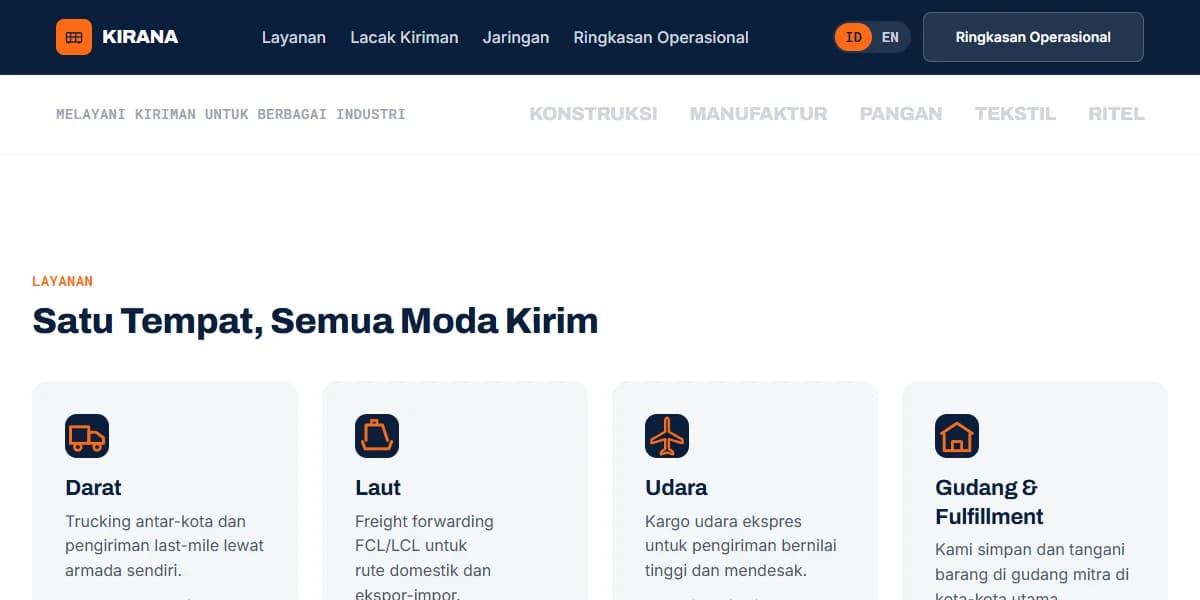
This Kirana Logistics demo was built by us as an example of the design, not a paid client website. It contains a tracking page that searches for shipment status based on the receipt number, a tariff estimate calculator based on distance and service type, a summary of land, sea, air, and warehousing services, as well as Indonesian and English language buttons that in this demo only change the menu and opening section. There are two parts in the demo that you need to pay attention to: the tracking feature that truly displays shipment data must be connected to your operational system, and the tariff calculator which we discuss separately below.
What you get
For logistics companies, the content that potential clients usually use to filter includes:
- Service areas written down to the city and regency level, with details on which areas you serve directly and which ones are handled by partners
- Types of fleets along with their cargo capacity and truck bed shape, from pickup trucks to trailers, plus information on refrigerated fleets if available
- Types of services clearly differentiated: full loads, combined loads, inter-island shipping, document handling, and warehousing
- How customers can track the location of their goods, including if the answer is still in the form of daily reports from your staff
- Claim terms: limit of liability, how long damage reports are accepted, what documents need to be attached, and how long the process takes
- Information on shipping insurance, whether it's included or added separately
- Payment terms: whether it's subject to payment terms or not, how many days, and what billing documents you issue
- Legal entity, transportation permit, office and warehouse address, as well as the name and email of the operational person in charge
- Quote request form that already asks for route, type of commodity, volume, and shipping frequency
What we do not recommend at the beginning: a tariff calculator that produces a definite number. Prices in logistics are determined by the route, type of commodity, monthly volume, loading and unloading waiting time, and the contents of the annual contract, so one number from a calculator is almost always off the mark. In the procurement environment, an incorrect number has a long lifespan: potential clients copy it to compare vendors, compare it with your official quote which is higher, and then ask about the difference at the first meeting. A tariff range for main routes along with factors that increase it provides a similar picture without locking you into one number.
Pricing for a logistics website
Logistic companies usually need more than one page, so the Business package, Rp 5.000.000 with a processing time of 1 to 2 weeks, is more suitable. It contains a lot of things: separate pages for each type of service, a list of areas, a fleet profile with photos, a claims terms page, and a company profile that is complete enough for potential clients to use when registering you as a partner. The package also includes a blog, which in this field is usually used to write technical things such as inter-island shipping documents.
The Starter package, Rp 1.500.000 with a processing time of around 3 days, is sufficient if you serve one mode of transportation in one area and only need one page containing services, areas, and contacts. A comparison of the contents can be found on the package page.
Questions we often get from logistics companies
- Our rates always go through a quote. Then what's filled in the price section?
Fill it in with how you calculate. Mention the basis of the calculation, whether per kilogram, per cubication, per freight, or per container, then list the factors that change it such as distance, type of commodity, need for special fleets, and waiting time. Add how long your quote is usually sent after the request is received. The procurement section that reads it can already estimate whether you are worthy of being included in the list, and they know exactly what data they need to prepare.
- Prospective clients ask for legal documents during vendor registration. Should they be uploaded to the website?
Mention the documents you have and that their copies are available upon request, but don't upload the files themselves to the public page. NPWP, deeds, and company account numbers that can be downloaded by anyone are ready-to-use materials for scams posing as your company. Just write the legal entity number and transportation permit, which can indeed be checked with the relevant agencies.
- Do we need to track shipment numbers on our website?
It depends on the system you are currently using. If the shipment status is already recorded in the operational system and can be accessed via API, connecting it to the tracking page is a reasonable task, with a different calculation from a static website. If the status is still recorded in a WhatsApp group and spreadsheet, the tracking page will display outdated data by half a day. In that case, writing the name of the officer who can be contacted along with their response hours is more trusted by clients.
- Our clients are companies and don't use WhatsApp for official matters. How should we contact them?
Put your company email and office phone number as the main contact, complete with business hours and estimated response time. WhatsApp is still provided as one of the options, because many field staff use it. What helps the most is the quote request form that already asks for routes, commodities, volume, and frequency, so your first response already contains numbers and the discussion moves one step forward.
- Does our website need two languages?
It's necessary if you handle exports and imports or serve foreign company representatives, because those who assess you there are often not Indonesians. If all your clients are domestic companies, one language is better: two languages mean that every change in claim terms or service areas must be written twice, and the version that is forgotten to be updated is usually the one that is rarely opened.
Next step
Compare what each package includes side by side, or first read what to prepare before you order.
Related pages
Company Profile Website Design
Company profile website design: services, projects, legal details, and contact information that prospective clients can verify. See the demo, from Rp 1.500.000.
Creative Agency Website Design
A creative agency website contains case studies along with their processes, team profiles, and how to start a collaboration. See the demo, starting from Rp 1.500.000.
AI Automation Website Design
Website for an AI automation service, with before-and-after workflow examples, service limits, and technical details. See the demo, from Rp 1.500.000.
Online Store Website Design
Online store website design: a catalog with ordering over WhatsApp, or online checkout and payment. From Rp 5.000.000.